Prediction Market Hedging.
Hedge real positions with binary event markets — Kalshi, Polymarket, normalized.
Map a long BTC, S&P, oil, or importer book to a prediction market hedge. Query across Kalshi and Polymarket, inspect depth, watch probability deltas, and route the hedge through your venue. Prediction market hedging gives you binary event cover that options, CDS, and futures cannot reach.
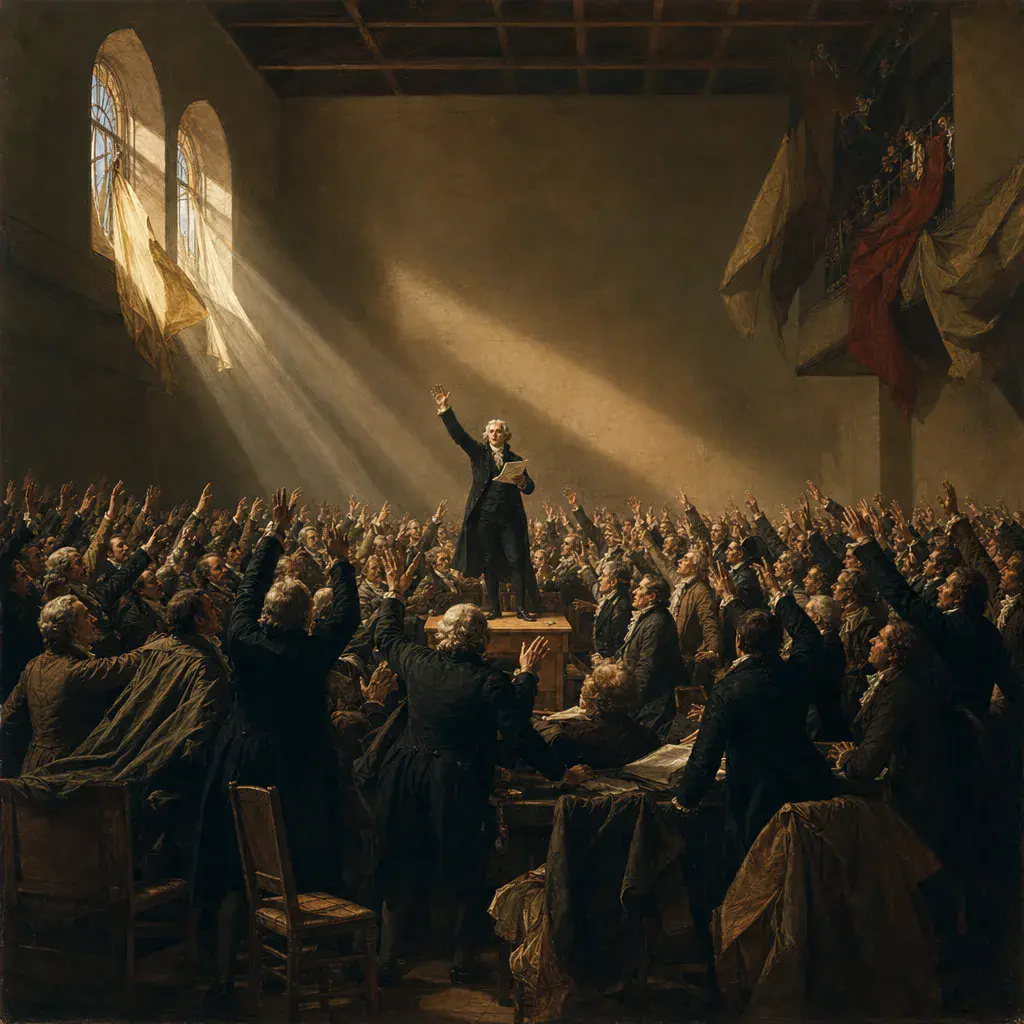
Tennis Court Oath, June 1789 — civic gravity meets binary outcome.
Who hedges with prediction markets?
Crypto desks, macro funds, corporate planners, AI agents, and tail-risk shops all run prediction market hedging — different exposures, different sizes, different cadences.
Crypto trader
Tail protection on long BTC / ETH books
Buy YES on "BTC < $80k by EOY" or "ETH < $2k Q4"
GET /api/public/query?q=BTCMacro hedge fund
Recession, election, and rate-path hedges across the book
Buy YES on "US recession 2026"; buy NO on "Fed rate cut Dec 2026"
GET /api/public/query?q=recessionCorporate FP&A
Tariff, regulation, and election-outcome hedges on operating exposure
Buy YES on "Trump tariff escalation 2026" if importer
GET /api/public/query?q=tariffAI agent / quant
Automated risk gate — query → size → execute on drawdown trigger
Programmatic basket: query markets correlated to portfolio P&L
GET /api/public/queryTail-risk shop
Cheap binary tail exposure on low-probability events
Buy YES on a long-tail event at 0.05 — pays 1.00 if it hits
GET /api/public/screenHedges you can build today
Concrete real exposures mapped to live prediction market contracts on Kalshi and Polymarket. Use these as starting templates — actual sizing depends on depth, fees, and basis tolerance for the specific contract.
Long BTC
BTC < $80k by EOY 2026
Buy YES
Pays $1 if BTC drops below threshold
Long S&P 500
US recession 2026
Buy YES
Recession typically coincides with equity drawdown
Long EM equities
Fed rate cut > 100bps in 2026
Buy NO
Aggressive cuts often follow EM-negative shocks
Long oil
Iran–Israel ceasefire 2026
Buy YES
Ceasefire removes the geopolitical premium in crude
Importer P&L
Trump tariff escalation 2026
Buy YES
Tariffs hit importer margin directly
Long bonds
Inflation > 4% by year-end
Buy YES
High inflation pressures long-duration bonds
Long DXY
Fed rate cut > 100bps in 2026
Buy YES
Aggressive cuts typically soften the dollar
Election outcome book
Specific election outcome contract
Buy opposite
Direct binary offset to the original wager
Long China equities
China–Taiwan incident 2026
Buy YES
Geopolitical shock drives direct equity drawdown
Property catastrophe
Named hurricane / weather event
Buy YES
Direct binary cash on catastrophe occurrence
How to build a prediction market hedge
Three steps. Query candidate markets, inspect depth, route to your venue. SimpleFunctions provides query and inspect — execution stays at the venue.
01
Query
Find candidate markets across Kalshi and Polymarket for your exposure topic.
GET /api/public/query?q=tariff02
Inspect depth
Check probability, bid/ask spread, open interest, and settlement source for the contract.
GET /api/public/market/{ticker}03
Execute
Route the hedge through your venue connection. SimpleFunctions does not broker — execution stays at Kalshi or Polymarket.
kalshi.com or polymarket.comHedge query — example response
One query returns candidate markets across both venues with probability, depth, and an absolute next-action graph for inspection and monitoring.
GET /api/public/query?q=Trump+tariff+escalationJSON · 200{
"matches": [
{
"venue": "Kalshi",
"title": "Trump tariff escalation by Dec 2026",
"yesPrice": 0.78,
"openInterest": "1240000",
"depth": { "bid": 0.77, "ask": 0.79, "topSize": "12500" },
"settlement": "Binary YES/NO at deadline",
"nextActions": {
"inspect": "https://simplefunctions.dev/api/public/market/<ticker>",
"history": "https://simplefunctions.dev/api/public/market/<ticker>/history",
"monitor": "https://simplefunctions.dev/world?focus=tariff",
"execute": "https://kalshi.com/markets/<ticker>"
}
}
]
}Prediction market hedging vs options, CDS, futures
Prediction markets fill a gap traditional hedges miss — discrete real-world events with binary settlement. Where they win, where they lose.
What prediction market hedging cannot do
Honest constraints. Read these before sizing — basis risk, depth, and the broker line are the real fences around prediction market hedging.
Hedge nine-figure size in one contract
Liquid Kalshi / Polymarket contracts quote $100k–$1M depth at the touch; the long tail is thin. Size by depth and basket across correlated contracts.
Replace continuous-payoff hedges
Prediction market settlement is binary YES / NO. Real positions move continuously — basis risk is the central design constraint.
Cover events that have no market
If no Kalshi or Polymarket contract exists for your exposure, there is no native hedge. Use the screen API to find adjacent contracts, or stay with traditional instruments.
FAQ
What is prediction market hedging?
Prediction market hedging means using binary event contracts on Kalshi or Polymarket to offset exposure to a real-world event. You map a real position (long BTC, importer P&L, long S&P) to an event market that correlates with the risk you want to hedge, size the position by depth and budget, and execute through the venue.
Who hedges with prediction markets?
Crypto traders hedging tail risk on long BTC and ETH books, macro hedge funds hedging recession and rate-path exposure, corporate FP&A teams hedging tariff and regulatory risk, AI agents and quants running automated risk gates, and tail-risk shops looking for cheap binary tail exposure.
Can hedge funds use prediction markets for hedging?
Yes — Kalshi is CFTC-regulated and accessible to US institutions; Polymarket is offshore and used by non-US funds. Liquidity varies by market and rarely supports nine-figure size in a single contract, so funds typically size by depth and basket across correlated contracts.
How do you hedge BTC with prediction markets?
Buy YES on a "BTC < $X by date" contract proportional to the protection you want. The contract pays $1 if BTC closes below the threshold and $0 otherwise; cost is roughly the implied probability. Polymarket has the deepest crypto-event books today.
How do you hedge tariff exposure with prediction markets?
For an importer with margin compression risk on tariff escalation, buy YES on a "Trump tariff escalation" contract sized to the projected margin impact. The payoff offsets the margin loss if tariffs land. Kalshi has the regulated tariff and policy markets in the US.
How does prediction market hedging compare to options?
Options hedge asset-price moves; prediction markets hedge discrete real-world events. Options have deep liquidity on majors but no native way to hedge "did event X happen". Prediction markets have native event coverage but thinner liquidity and binary settlement (basis risk vs continuous payoff).
How does prediction market hedging compare to credit default swaps?
CDS pay out on credit events for a specific issuer; prediction markets pay out on any defined real-world event with a settlement source. PMs are cheaper to enter and far more event-flexible, but have lower notional capacity and binary payouts vs CDS's par-recovery payoff.
What is the maximum size you can hedge in a prediction market?
Depends on the contract. Liquid Kalshi and Polymarket markets quote $100k–$1M depth at the touch; long-tail markets often have only a few thousand dollars. Always inspect depth via /api/public/market/{ticker} before sizing — the SimpleFunctions API exposes this.
Can AI agents construct prediction market hedges automatically?
Yes. Agents query SimpleFunctions for candidate markets matching an exposure, inspect depth and probability, and either flag the hedge for operator review or execute through a configured venue connection. The full workflow is one query → one inspect → one execute call.
What is the API for prediction market hedge construction?
GET https://simplefunctions.dev/api/public/query?q=<topic> finds candidate markets across Kalshi and Polymarket. GET https://simplefunctions.dev/api/public/market/{ticker} returns depth, history, and settlement details. Execution happens at the venue — SimpleFunctions does not place orders.
Where does the hedge execute?
At the venue. SimpleFunctions ships the query, inspect, and routing primitives; execution happens at Kalshi or Polymarket through your account.
What about basis risk in prediction market hedging?
Prediction markets have binary payouts; real positions move continuously. A hedge that pays $1 if recession hits will not match the exact P&L of an equity drawdown. Basis risk is the central design constraint — most hedges either accept it or layer multiple correlated contracts to approximate continuous payoff.
Kalshi vs Polymarket for hedging — which one?
Kalshi is CFTC-regulated, USD-funded, US-friendly, with the deepest macro / policy / rates / election books. Polymarket is offshore, USDC-funded, with the deepest crypto / geopolitics / sports / cultural books. Most hedge constructions span both via the SimpleFunctions normalized API.
Related surfaces
Event Probability API
Real-money event probabilities — query elections, policy, macro, crypto.
Prediction Market API
Kalshi + Polymarket normalized — query, market, history, screen.
Prediction Market Execution
Intents, triggers, routing, monitoring for hedge workflows.
Prediction Market Index
Live volatility, geo risk, breadth, activity gauges.
World State API
Live event-probability feed for agent-native consumption and institutional research.
Institutions
Prediction market infrastructure for funds and corporates.
Hedge Fund
Buyer-specific page for funds and trading teams.